A universal public option for Phoenix
Waymo
for all.
Keep the light-rail spine. Build a reserved-lane rapid-bus grid. Use pooled autonomous buses, vans and cars to reach every address. One public network replaces millions of parked assets with vehicles that keep moving.
Open the one-page infographic ↗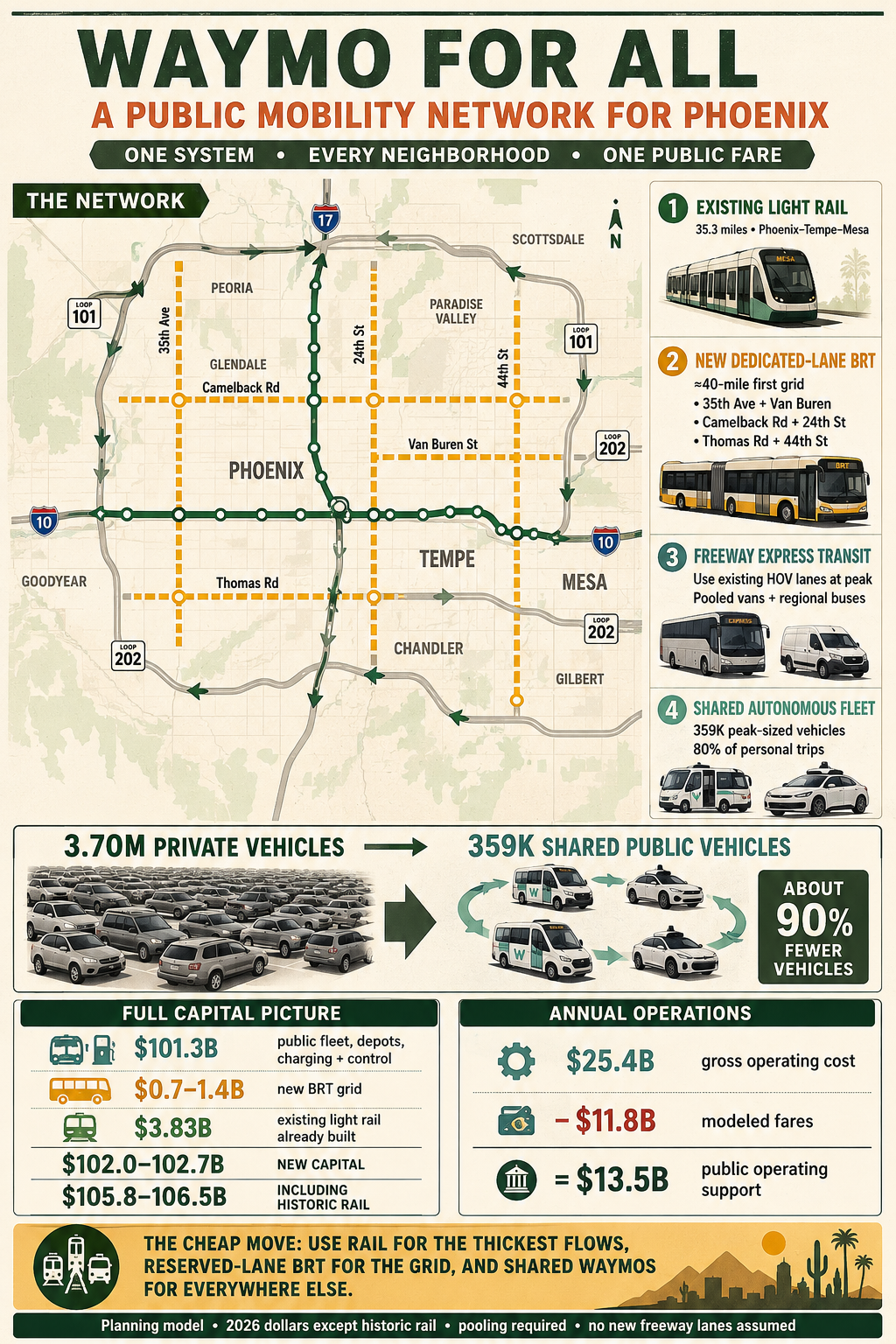
The main plan
Rail spine.
Rapid grid.
Shared fleet.
This is not 359,000 cars wandering independently. The system pools the thickest commute flows into rail, autonomous buses and vans; small robotaxis fill the geographic and accessibility gaps.
Existing railNew BRTFreeway express transit
Phoenix–Tempe–Mesa and Metro Parkway–South Phoenix become the high-capacity trunk. Historic nominal capital: approximately $3.83B.
35th/Van Buren, Camelback/24th and Thomas/44th get dedicated lanes, level boarding, off-board fares and signal priority.
Give pooled vans and regional buses priority in existing HOV lanes during peaks. The model assumes no new freeway lanes.
Cars handle low-density and accessible trips; pooled vans and autonomous buses absorb commute demand and feed rail.
A morning in the network
Mesa home.
Tempe job.
The rider requests one trip—not three separate services. The public dispatcher chooses the fastest pooled itinerary, guarantees each transfer and charges one fare.
- 01Front door
A pooled autonomous van meets the rider near home in Mesa. No household car, parking hunt or fixed-route detour.
- 02Gilbert Road station
The van groups nearby riders headed west and delivers them to the A Line immediately before the train arrives.
- 03Rail to Tempe
Light rail carries the concentrated flow past congestion to Downtown Tempe or ASU without adding another car to US-60 or Loop 202.
- 04Last mile
Walk to a nearby workplace or board a waiting shared vehicle for the final connection. The same app protects the transfer.
The operating rule: the dispatcher should not send a solo Waymo from Mesa to Tempe when a pooled feeder plus rail can provide a competitive trip. Convenience stays door-to-door; capacity comes from sharing the middle.
Full new-capital estimate
What the public
actually buys.
The default peak-hour model requires about 359,000 public vehicles to shift 80% of personal trips. The capital estimate includes a 15% spare fleet and a 30% allowance for depots, charging, control systems and contingency.
Low-density, disability, late-night and first/last-mile trips.
Neighborhood feeders and cross-town pooled service.
Repeatable BRT and neighborhood routes carrying the peak.
Distributed facilities, software, backup power and contingency.
Recent FTA project-cost range; existing streets become transit lanes.
Existing $3.83B rail system is already built and is not charged again.
GROSS ANNUAL OPERATIONS$25.4B
−
MODELED FARES$11.8B
=
PUBLIC OPERATING SUPPORT$13.5B
Planning assumptions, not vendor bids: cars $160K, vans $260K and 24-seat buses $850K; default average occupied loads are 1.8, 5 and 14. Operating figures exclude capital amortization, financing, vehicle replacement, land, insurance uncertainty and proprietary autonomy licensing.
Evidence